Wednesday, August 4, 2010

Some rare links

I do not do links often – so they have to be good.  These two are gems and I am (a) sick in bed and (b) working on a very long post on a new topic which may not be posted as I am not sure I understand it…

The first link is to Jim the Realtor who has been doing some down-in-the-weeds looking at shadow inventory in San Diego.  His conclusion is non-consensus – the problem is massively overstated:

More on shadow inventory

His observation accords with the conference calls of many banks.  Southern California is – if you believe the bank spin – and you now have reason to – better than most commentators think.

Florida remains worse – possibly much worse.  (Alas I have a small bet on a regional bank in Florida that is not quite working out…)

The response to Jim the Realtor is to argue that the true “shadow inventory” is in property not yet foreclosed on.  Alas in Southern California it seems the delinquent inventory is falling too.  (Again Florida looks worse…)

The second link is a detailed reading of the Valukas report into Lehman’s failure.  The “Economics of Contempt blog” (which I should put on my blog-roll) goes through the ways in which Lehman faked its liquidity.  [I was short Lehman at various times and it never even occurred to me that they were faking their cash balance…]  This does not go to the core issue of solvency – but it does speak to the culture (and possibly to criminality).

Economics of Contempt on Lehman liquidity.

Happy reading…


J

Monday, July 26, 2010

California Dreaming: requesting comments from Wachovia customers

The defining character of bank results up until Wells Fargo was (a) rapidly improving credit and (b) declining revenue.

When I state that bank credit in the US is clearly and unambiguously improving my email runs hot with people arguing that the banks are faking it.  But they are not – and there are lots of tests of that.  The problem was and remains revenue – the extreme out come is the Japanese outcome – banking without revenue, credit losses, glamour or highly paid bankers.

But the Wells Fargo result was different.  Revenue was flat.  That result is so much stronger than the competition it is silly.  Moreover interest margins were up.  Again – this differs sharply from the competition.  One correspondent wrote to me and tells us that Wells Fargo shows how it is done.  However that does not do the problem justice.  The numbers do not tell you how it is done – they just tell you that it is being done (provided the numbers are not faked).

My best guess is that Wells is using its (legendary) ability to extract revenue from a customer base to either service better or screw over (depending on your perspective) the customers of Wachovia.  This quote I think is the story:

The merger integration activities are proceeding on track and the combined company continues to produce financial results including revenue synergies better than our original expectations.

Now I have seen a lot of banking mergers with dodgy estimates of “revenue synergies”.  After all revenue synergies means extracting more financial services revenue from customers than they were previously paying – and – as even the most casual observer has noticed – most Americans pay a lot of revenue to financial institutions. 

But in this case they are ex-post claiming “revenue synergies” and – the numbers show – are probably achieving them.

So this is a call to former Wachovia customers.  What is it that Wells Fargo has changed so that you pay more money to the bank? 

Comments please.


PS.  Obviously this is part of it – but it does not explain all the numbers:

Year over year, CDs declined $63 billion, primarily the result of $57 billion of higher-cost Wachovia CDs maturing, yet total core deposits were down only $3.9 billion from a year ago.  Checking and savings deposits represented 88 percent of total core deposits. Our average deposit cost was 35 basis points.”

Saturday, July 24, 2010

Already a short follow up on Tarrants and Astarra

The local paper has reported that Ross Tarrant has closed the financial planning arm of his business

Ross Tarrant’s business survived the financial crisis – according to quotes attributed to him in the local paper – by taking undisclosed commissions called “marketing allowances” to direct money into Astarra funds.

His business however it appears does not survive his clients having their retirement savings stolen.

The Tarrants website is dead today too.

Australia has a system of privatized social security.  The US flirted with such a system too.  However this case shows that getting ordinary members of the public to deal with intermediaries (brokers, financial planners etc) can often be a quite one-side affair.  The local paper also points to a local (coal) miner who lost $200 thousand in this debacle.  He says he would never have invested had he known about the secret commissions.  I guess that is why they were secret.

Astarra and the financial planners – Ross Tarrant tells us how his business survived the financial crisis without shedding a job

By now it is obvious – the money in the Alpha Strategic Fund – now named the Astarra Strategic Fund – has been stolen. Who was the actual controller of this theft and who was “just following orders” has yet to be judicially determined – but Shawn Richard – the front-man for this mess in Australia – put forward (under privilege) the Nuremburg defense: he was just following orders from Jack Flader in Hong Kong.

More interestingly he testified that he paid large undisclosed commissions to financial planners – sometimes going under the rubric of entirely undocumented loans and sometimes called “marketing allowances”. The loans were particularly peculiar – after all when was the last time a financial institution “lent” you a million dollars based on a handshake with no documentation and not recorded in any accounts?

Anyway Ross Tarrant – who I gather perceives he has done nothing wrong – was the recipient of “marketing allowances”. He runs a large financial planning firm in Wollongong NSW. The local paper has reported that he has come out fighting. This may be the only time in my life I have quoted the Illawarra Mercury with approval – but this deserves to be quoted in full…

Tarrants managing director Ross Tarrant has broken his silence on bombshell claims his company accepted secret, illegal kickbacks from failed fund manager Trio Capital.

A NSW Supreme Court hearing last week was told Tarrants allegedly accepted $840,000 worth of secret payments last year as an incentive to invest clients' money in the failed venture.

In a statement released yesterday, Mr Tarrant described the money as a "marketing allowance" and said while the firm did not normally accept commissions, the one-off payment helped the firm survive the global financial crisis.

"During ... one of the greatest financial crises of our time, the receipt of this once-off marketing allowance from Astarra enabled Tarrants to weather the GFC without shedding a job," Mr Tarrant said.

"After receiving the marketing allowance from Astarra, Tarrants returned to a 98 per cent fee-for-service position."

I do not think this needs any embellishment.

(PS. For those that do not know the Mercury is a small – usually reactionary – local paper - which - given the style - I incorrectly thought was News Corp)

Wednesday, July 21, 2010

Part VI in the Ed Hugh series – Emporiki decides not to compete on deposits

Lets recap my arguments from the early parts of this series.  In Part 2 of the series I showed that if the Greek sovereign defaults either (a) it leaves the Euro and forces all Greek companies to convert all cash assets and liabilities to Drachma or (b) the Greek institutions including – say National Bank of Greece – will wind up going bust.  In the archetypical sovereign default with a fixed currency (Argentina) not only did the sovereign default – but all private debts got redenominated in Pesos.  I argued the same must happen in Greece if Greece were to default because Greece would want to save their institutions.  Nobody has argued why this won’t happen.  Then again nobody has provided a decent mechanical explanation for how it does happen – we don’t know how to leave the Eurozone even if you want to.

In Part 3 of this series I showed you the balance sheet of Emporiki – the Greek controlled subsidiary of Credit Agricole.  The balance sheet showed 8 billion euro of interbank funding funding the Greek business.   I argued that if Greece went off the Euro those interbank funds would be repaid in Drachma with a loss determined by the post-default trading level of the Drachma.    

Every Euro of deposits raised in Greece is a Euro that does not flow across the Greek-French financial border and it is a Euro not subject to devaluation if Greece were to go off the Euro standard. 

In my view the real risk to Credit Agricole in Greece is NOT credit losses (their lending has not been outrageously bad).  The real risk is that Greece leaves the Eurozone and the assets and liabilities of the Greek banks are revalued in Drachma. 

Into this I want to throw a slide out from Credit Agricole’s recent presentation on how they are dealing with their Greek subsidiary.  They are making a conscious decision NOT to pay Greek interest rates on term deposits – and they expect their deposit book to shrink from 22.5 billion Euro to 15.8 billion Euro.  Presumably they will need to fund another 7 billion Euro from France.

image


What to call this?  Double or nothing!  If Greece leaves the Eurozone Credit Agricole has almost doubled their losses.  But – if Greece stays in the Eurozone – hey – they make more interest margin for the next few years because they pay cheap French financing cost to fund Greek business.  [Isn’t that how they got into this mess in the first place?]

They better hope I am not right.  If I am I can expect the resignation and disgrace of Credit Agricole’s CEO.  This is a dangerous game.

--

Tuesday, July 20, 2010

Turning Japanese? Comments on the latest bank results

I am thinking out loud here – and hope for comments.  For our portfolio it has not been a happy few days.  You will need to click for the tables.

==============

With a due apology to the Vapors the new bear case for American banking was laid out in recent results (especially Bank of America).

No sex

No drugs

No wine

No women

No fun

No sin

No credit cards

No wonder it’s dark…

I’m turning Japanese

I think I’m turning Japanese…

The second post on this blog (back in the days when I had twenty readers) ran through the financials of a typical regional Japanese bank.  I picked 77 Bank (because I once owned it) but I could have picked one of about fifty others.  The bank had a great looking deposit franchise off which they made no revenue.  After all how do you make any money out of a deposit book when interest rates are zero?  It is impossible to make deposit spread.  And – in Japan – there was such anemic loan demand that loan spreads had collapsed to near zero.  The bank had fabulous credit but remained vulnerable to even the smallest credit downturn because there was no pre-tax, pre-provision earnings to offset the losses against.  Anything above the near zero losses would impair capital.  This was a nightmare of banking without revenue, without credit losses and entirely without glamour.  If you were a shareholder at least you could shrink the bank and return capital (though the Japanese seldom do that).  If you were an employee it was worse – all except the very senior employees were paid below what they might have earned had they chosen to be an industrialist rather than a banker – and pay rises were not possible because the banks could not afford them.  In America high bank revenue allowed some (very) highly paid employees – but this did not happen in Japan. 

I have maintained throughout this blog that I thought that zero interest rates in America would have a different outcome to zero interest rates in Japan because Japanese banks are predominantly deposit franchises and zero interest rates are very bad for them – but that American banks – especially larger American banks – are fundamentally lending franchises and zero interest rates would not impair their ability to make a spread on the loan book.  In other words I thought that American regional banks (and super-regionals like Wells and Bank of America) would not become large versions of 77 Bank but instead would return to strong profitability.

This is a deep and fundamental call – and about 25 percent of our portfolio at Bronte is based on this call – so – to put it mildly it matters to us.  There are two historic models for post-banking collapse banking sector recoveries.  There is the typical model applied in Scandinavia and for that matter in Australia after its last round of banking troubles (1992) but also in Thailand, Malaysia, Indonesia and many other places.  That model has the competition wiped out or seriously impaired by the crisis followed by (a) a slow repair of credit impaired balance sheets offset by (b) solid profitability as competition is sharply reduced by the crisis and banking services remain central to the economy.  In this model banks either die in the crisis or give you 10 to 20 fold returns from the bottom of the crisis as the surviving banks mop up the (very rich) spoils.

There is an atypical post-crisis banking situation which was Japan.  In Japan the banks were always deposit rich (a function of their historic savings culture described in this post) but they became even more deposit rich as customers cash preference increased to hitherto unheard of levels.  Loan demand however turned completely anemic – and though competition was somewhat reduced margins were crushed to the point that banks were – at best – marginally viable. 

Lots of readers ask me to explain my Bank of America position – especially given I have been so skeptical of their past accounts.  The explanation is easy – I have seen this movie before.  I looked at the competition a few years ago (essentially a massive shadow banking system outside the majors) and note (with glee) that this low-margin competition is simply no longer there – and as far as I can tell – it is not coming back.  I believed that bank revenue would be strong – at least for the survivors – and if you put a five-to-ten-year time horizon hat on.  More than that – I thought the revenue – spread over a few years – would be more-than-enough to cancel out the excesses of the last boom.  [I expressed that view several times on the blog…]

But there is that other movie.  That movie is in Japanese – only the subtitles are in English.  A good proportion of my readers are bankers.  Dear Readers, you better hope it is not that that movie – because if it is your bonus will be small for the next few years – after which you will negotiate a pay cut.  Beyond that your income will go into a bit of a decline.  One day some of you will wake up and find that – as a fairly senior banker – you are paid about as much as policeman.  Welcome to the middle-and-lower-middle class.  In a Japanese scenario bankers are paid less – much much less.

The important thing as a stockholder however is not what next quarter earnings will be (they will be difficult).  It is whether – five years from now the surviving American banks are milking their privileged position as survivors or whether the margins have collapsed as-per-Japan making banks horrid businesses. 

It is in this context I want to make some comment on recent bank results.  I am not interested in whether next quarter will be difficult.  I am interested in whether we are “turning Japanese”.

Firstly credit is better than even the most ardent bulls would have predicted at the base of the crisis.  If you are still bearish big American banks on credit you either think they are faking it on a grand (even criminal) scale or you believe in a massive double-dip or you are just not looking.  Credit is unambiguously improving in the numbers.  Most the bears in the financial blogosphere – and there are many – were flat wrong on how long credit would take to turn.    

Properly adjusted delinquency is falling (albeit slowly) and charge-offs are falling relatively fast.  Charge-offs on mortgage credit at JPMorgan for instance dropped by a third during the quarter.  JPM however did state in the conference call that the new lower level of credit losses were flat over the quarter and Jamie D was careful to indicate that you should not extrapolate the falling credit losses into future quarters.  That said – even sustainably higher than historic (but not threatening) sustained credit losses should not be a problem because you should be able to price the higher credit loss expectations into loan margins. 

Which of course brings us to the bad part of the bank results – revenue.  The revenue situation has suddenly got ugly – so much so that it challenges the central basis over which part of our portfolio is organized – which is that we are not replaying the Japanese movie – and that bank revenue will be fine long term just as it has been after most (but not all) banking crises.  The trillion dollar question in bank valuation is “are we turning Japanese?”  As the Vapors suggested in their classic 1980 track – turning Japanese is no fun (it is also no sex, drugs, wine, women or sin – and in the banking context it is no credit cards). 

The market did not like the JPMorgan result and they hated the Bank of America result.  The problem is revenue decline – and guidance as per revenue decline.  The guidance is simply horrid.  BofA is not known for down-beat conference calls – but this was decidedly downbeat.  I would love to summarize it – but – hey – but Stephen Rosenman has done so far better than me.  Sorry to copy in full – but you can go to the original:

Bank of America's (BAC) conference call is a must read. Warning: it is not for the faint of heart. Its implications for banking, now that Congress has passed credit card and financial reform, are not pretty.

1. The Card Act is expected to cost $1 billion after tax.

2. Regulation E/Overdraft policy changes have already cost $1 billion after tax. The fourth quarter of 2010 will see a further reduction of $2 billion pre tax.

3. The Dodd-Frank Bill impact at this point is uncertain because hundreds of rules need to be written still. It is expected to be very costly.

4. The Durbin Amendment in the Financial Reform Bill is expected to decrease debit card revenue each year by as much as $1.8 to 2.3 billion starting in Q3 2011. BAC expects to take a $7 to $10 billion charge in goodwill in Q3 2010 due to the impairment of the debit card goodwill.

5. Net interest margin is dropping. BAC's dropped 16 bp to 2.77%. Per the call, the low interest environment is flattening the returns banks can get for their borrowed money. Loan demand is weak. As a result, net interest income was down over $800 million from Q1 2010.

These 5 banking nightmares will likely visit other financial institutions. BAC is the first to quantify some of them. BAC reiterates throughout the call that it has no idea how to "mitigate" these. While the legislative action may be intended to help level the playing field for consumers and to prevent banking excesses, for now, it appears to be leveling the financial institutions.

It is surprising that Congress would inflict these new burdens on the banking industry in a fledgling recovery. The idea was to prevent new bubbles from forming. It would be sadly ironic if the reforms were to cause the recovery to fizzle. After all, how many recoveries have occurred without the banks?

Disclosure: No Positions

I read Rosenman’s piece and got bullish.  The reason is that 1, 2, 3, and 4 on this list are one-offs.  They will compress margin – but they do not lead to sustained margin pressure.  That is fine because the bank will – over time – be able to make up the margin elsewhere.  As Jamie Dimon might say – if the diner can’t charge for ketchup they might just charge more for the hamburger.  They are – if I might put it this way – not Japanese style events.  In Japan the bank can’t seem to get away charging for anything

Alas number 5 on the list is Japan writ-large.  Loan demand remained anemic for decades and eventually loan spreads went close to zero.  Loan spreads are falling normally – after all older high rate mortgages are refinancing into lower rate mortgages – and I think that will be fine.  As long as the competition is not to bad the bank will keep a good margin.  Alas some parts of the bank have very bad loan demand.

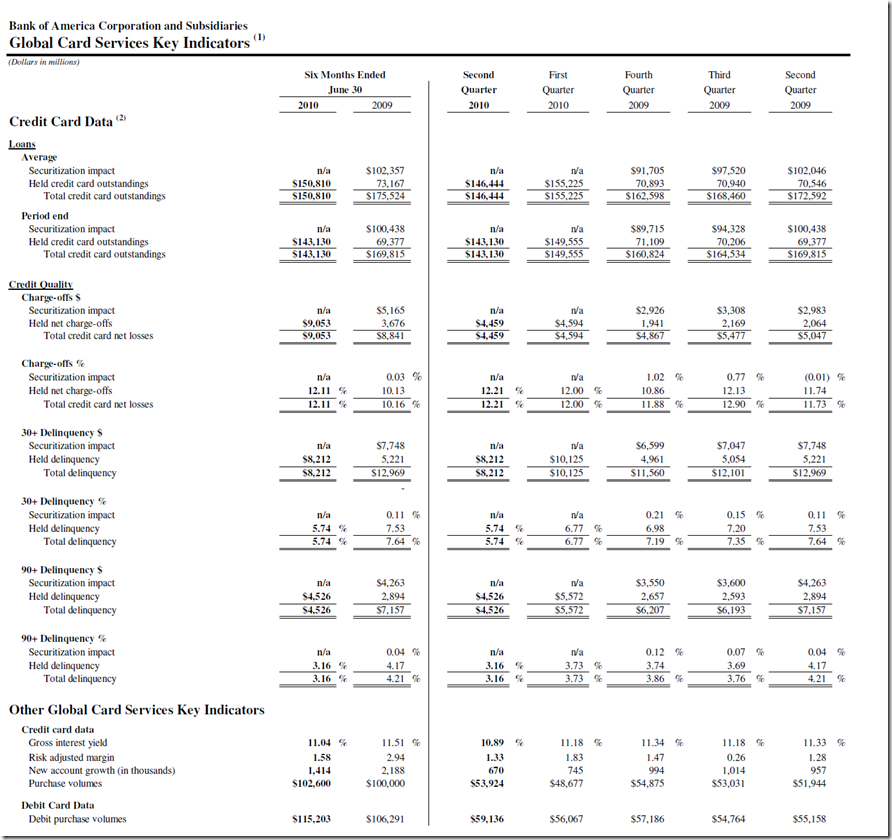
Front-and-center is credit cards.  BofA has one of the lowest spread, highest credit quality card books in America.  Here is the quarterly data from their cards business.  (Remember to click for the full table… and you will need it for the conversation below.) 
image


Now note this is not a junky fee-driven credit card business.  The gross interest yield is only 10.9 percent (and falling!).  There are still new accounts.  But the balances outstanding are now only 143 billion – down from 169 billion.  This fall is happening across America.  The Federal Reserve data have total revolving consumer credit outstanding falling from 905 to 824 billion in the same period – but BofA is losing share (from 18.7 percent to 17.3 percent).  These are the highest spread product on BofAs book.  There is no obvious problem with originating new accounts – just maintaining balances.  In all of BofA’s results this the “most Japanese” thing you can see. 

The rest of the book – well margin is tight – but it does not look to be driven by the things which made Japan so painful for bank shareholders.  In the credit card book – not so much.

One thing however leaves me a little chirpier.  Purchase volumes actually rose – and they rose well in the quarter.  The quarter had almost Christmas purchase volumes.  The effect is even more pronounced with debit purchase volumes (ie purchases that do not create a debt).  The American consumer did not stop spending – more they just stopped borrowing.  I do not know how much of this is people stopping paying their mortgage but still paying their credit card – but there is some evidence that is happening.  Perhaps the strongest being JPM’s statement that about half of the JPM second mortgage where the primary mortgage is delinquent are still paying their second mortgage.  The same borrowers are also presumably paying off their credit card balance but intend to default on the mortgage.

Finally – and this comes to the competition point – the average yield on this credit card book is sub 11 percent.  That is a high interest rate for Bank of America but not a high interest rate for credit cards generally.  Despite the tone of the credit conference call (unremittingly bleak as to revenue) I suspect there is a little flexibility to increase pricing in this area.  After all the idea of a new securitisation driven credit card originator poaching the business – that seems unlikely.  But we will wait and see on that.

Business lending is NOT turning Japanese

Business lending volumes suck.  But hey – in non-Japanese fashion the margin on them is actually increasing – it was 2.32 percent verus 2.03 percent a year ago.  This is not turning Japanese – it is far more like a conventional post-crisis bank recovery in which margins get fatter. 

image

This does not look anything like a post-crisis Japanese bank – there the margins fell asymptotically to zero.

Finally – what is the long-term downside?

This gives me a little comfort – not much – but comfort in misery nonetheless.  Japanese banks have low single digit ROEs.  5% is sort-of-typical.  This would suggest that they should trade at very low multiples to book – but they do not.  In Japan a 5% ROE is not too bad – because it needs to be compared to a zero percent bond rate – as long as a bank earns more than its cost of capital it should trade above book – and 5% is more than the cost of capital in Japan.  So banks with shockingly and sustainably low ROEs trade above book.  They might actually a good investment relative to JGBs and you can get outperformance out of misery.  BofA is no longer trading far above book.  In a Japanese scenario I am not sure you lose to much.  But alas you can get really really bored waiting to make no money and misery can last a long time.

For comments please.


John

Post script: since I wrote this Goldies reported – and their revenue was also crunched.  So was their allowance for compensation – albeit from very high levels. 

Monday, July 12, 2010

Bank of America comes clean – well sort of …

Bank of America has finally admitted that it understated the quarter end assets and liabilities for the years 2007 to 2009.  It does not (yet) admit that similar transactions took place in many other years and it does not spell out the effect of these transactions on BofA’s need to carry capital.  To quote BofA’s local paper:

Bank of America Corp. has told securities regulators that it made six quarter-end transactions from 2007 to 2009 that were not in "strict compliance" with accounting rules.

In correspondence with the Securities and Exchange Commission, the Charlotte bank said the so-called "dollar roll" transactions were designed to meet internal balance sheet limits. The bank said it does not believe the transactions had a material impact on its financial statements, according to a May 13 letter posted by the SEC late Friday.

I wrote a post stating that BofA had long been reducing its quarter-end balances in March this year so this should not surprise regular readers.  Nor will not surprise regular readers of the Huffington Post and many other places where my article was reprinted.  I think the WSJ also had a poke at the story after my blog post.  Alas the story died down as BofA issued denials only to retreat from those denials in a (then private) letter to the SEC. 

BofA note that the transactions did not change reported profit.  I agree.  The transactions were however designed to shrink reported quarter-end balance sheet and hence reduce the apparent need to hold capital.  One of the reasons why BofA was short capital when the crisis came was that they did things like this to reduce the stated need for capital and they ran capital close to the “apparent” minimums. 

Anyway there are things that bug me about BofA’s admission.  Firstly at senior management it appears that they did not even know they were doing this.  The company denied the bleatingly obvious in the aftermath of my original blog post.  I do not think they were directly lying – the better explanation is that they simply did not know.  Moreover they now state that the transactions “were designed to meet internal balance sheet limits”.  In other words some internal part of the bank was using more balance sheet – hence more capital – than it was permitted under internal risk controls and entered into quarter end transactions to hide it. 

Lets put this more directly.  BofA imposes internal risk controls (usually called limits).  BofA staff enter convoluted transactions to avoid having to meet those limits.  Head office does not know – and only in response to an SEC subpoena (following a blog post a nondescript fund manager in Australia) do they conduct a review and find these transactions.  This is – it seems – worse than the transactions itself.  What it demonstrates is that BofA does not police its own risk control rules until forced to by SEC subpoena.  Put that way you have to ask “who in BofA will be forced to resign?”

More pertinently – this could be spotted by a (very) careful reading of annual and quarterly reports from Australia.  Everything needed to demonstrate that there was something strange about quarter ends could be done by someone with the published annual reports and quarterly summaries.  If anyone on BofA’s board carefully read the accounts they would have spotted the same thing.  (I guess that this demonstrates that the entire BofA board did not or was not capable of undertaking such a careful reading of their own accounts.)

My original post did this for 2006.  In 2006 as I showed the quarter end assets were substantially less than the assets averaged over the quarter.  In some quarters the difference is 46 billion dollars (substantially more than the 10 billion admitted to in 2007-2009).  The same incidentally is true of 2005 and I think (though I have not rechecked) that I first spotted this in 2004.  So far BofA has not come clean about those years.  But then again we now know that head office did not know that within the bank parties were entering transactions designed to thwart internal balance sheet limits – so if BofA cares to check they will find that the problem exists over many years. 

My estimate is that – as a result of this transaction – BofA’s looked like it required about 2 billion dollars less capital than it should have been carrying had it stated its balance sheet fairly.  2 billion in capital is significant – but is remains small in the overall problems that BofA had during the crisis.  This is – in an accounting sense – a second-order issue.  But as a statement about BofA’s control culture it is not good.  [The culture of hiding risk taking however should – in a post-crisis environment – be relatively easy to address…] 

The unnamed counterparty

These transactions were done – according to press articles – with counterparties unknown.  It is passé these days to charge the prostitute but not to charge the John.  The press however would often prefer to report on the (high profile) John than the prostitute.  Either way I wish this were corrected.

The transactions designed to hide quarter-end assets and debt were described as “roll transactions”.  I guess I am new at this game but I had not previously heard that jargon.  Anyway – with a “roll transaction” there has to be a counterparty who is willing to prostitute their balance sheet and allow the “assets” (at least temporarily) to be stuffed in.  The willing whore in this case was almost certainly Japanese – at least for some quarters.  Japanese banks typically had average balances of securities LOWER than end period balances (Mizuho is an exception).  I once meticulously went through the quarterlies of MUFJ and found exactly this trend.  In their SEC filings MUFJ tends to report its capital (or at least it did in those days) as average capital to average assets.  (I guess that makes sense when their end-period assets are stuffed with assets parked from American banks.)

Still if some trader at BofA (or someone else wanting to skirt BofA’s internal controls) wants to park assets at quarter end – and to pay good money for that privilege – then who am I to suggest that otherwise lowly profitable Japanese banks should say no?  


John


Disclosure:  I have never thought that we should use the blog to “talk our book”.  We will occasionally explain why we own things (which I guess is talking our book) but we are happiest discussing what is wrong with our positions.  Our biggest position remains long Bank of America (and it is more-or-less the only stock I suggest when people want a stock tip).  BofA might argue that with friends like us they don’t need enemies.  Maybe that is true – but perhaps they need board members that can read accounts. (I am offering…) 

Also – for the SEC – note that BofA shareholders have suffered much already because BofA took too little capital into the crisis.  What you should be seeking from BofA is not penalties – it is a process for fixing their internal controls so that head office can ensure that divisions are not entering transactions designed to thwart internal controls.  Surely that is far more important than a rap over the knuckles? 

Hey – the SEC should not need to seek this.  BofA should just do it.  I anticipate being a shareholder in a decade – so this matters to me. 

General disclaimer

The content contained in this blog represents the opinions of Mr. Hempton. You should assume Mr. Hempton and his affiliates have positions in the securities discussed in this blog, and such beneficial ownership can create a conflict of interest regarding the objectivity of this blog. Statements in the blog are not guarantees of future performance and are subject to certain risks, uncertainties and other factors. Certain information in this blog concerning economic trends and performance is based on or derived from information provided by third-party sources. Mr. Hempton does not guarantee the accuracy of such information and has not independently verified the accuracy or completeness of such information or the assumptions on which such information is based. Such information may change after it is posted and Mr. Hempton is not obligated to, and may not, update it. The commentary in this blog in no way constitutes a solicitation of business, an offer of a security or a solicitation to purchase a security, or investment advice. In fact, it should not be relied upon in making investment decisions, ever. It is intended solely for the entertainment of the reader, and the author. In particular this blog is not directed for investment purposes at US Persons.